
Best AI tools for daily work have become a core part of how modern professionals operate in 2026. Artificial Intelligence has fully transitioned from experimental technology to an essential productivity engine used across offices, remote teams, and freelance workflows. Today, the best AI tools for daily work are not just answering questions—they are actively managing tasks, automating research, drafting content, analyzing data, and even executing multi-step workflows with minimal human input.
As of January 2026, professionals who rely on the best AI tools for daily work consistently outperform those who do not. Instead of wasting hours on repetitive actions, they delegate entire workflows to AI agents, use AI-powered research assistants, and automate daily operations. The impact is measurable: users of the best AI tools for daily work report saving 10–20+ hours every week while producing higher-quality results and focusing on strategic, creative decision-making.
The rapid evolution of the best AI tools for daily work has changed how freelancers, marketers, developers, managers, and entrepreneurs approach productivity. From AI writing assistants and autonomous research tools to agentic AI systems that browse the web and complete tasks independently, the best AI tools for daily work now act as proactive teammates rather than passive software.
In this comprehensive guide, optimized specifically for the keyword best AI tools for daily work, we explore the most powerful AI productivity tools dominating 2026. Each of the best AI tools for daily work featured here is selected based on real user adoption, expert analysis, and current capabilities as of mid-January 2026. We break down these best AI tools for daily work by workflow category, covering their pros, cons, pricing insights, and practical implementation tips.
Whether you are just getting started with automation or already experimenting with advanced systems, adopting the best AI tools for daily work will help you work smarter—not harder—in 2026.
Table of Contents
1. Writing & Content Creation: Craft Faster, Sound Smarter
Quality writing remains foundational for emails, reports, marketing, and documentation. AI tools now deliver polished, human-like output with brand consistency.
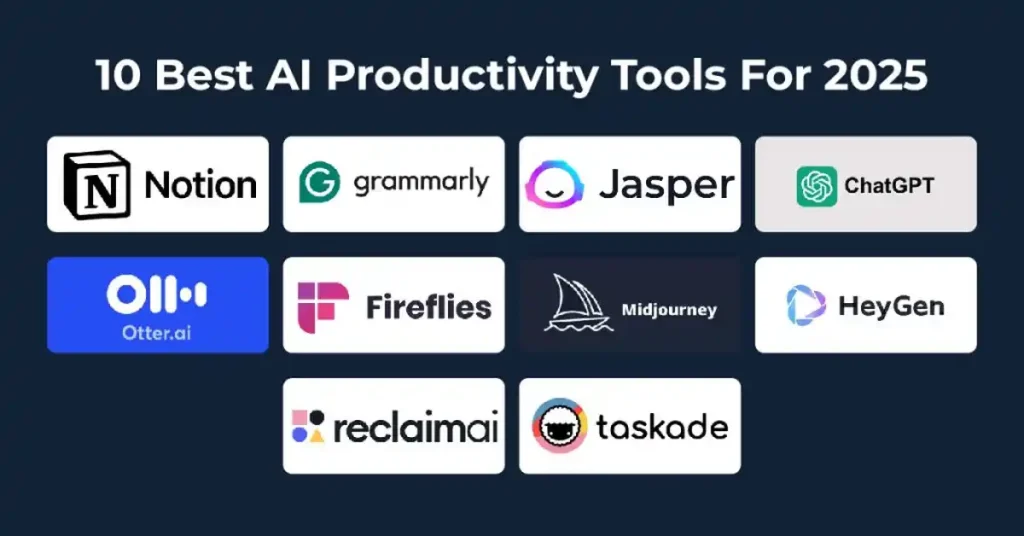
Jasper AI Jasper remains a powerhouse for marketing and long-form content. It excels at blog posts, ad copy, social media, and SEO-optimized articles using templates, tone matching, and multilingual support. Pros: Brand voice customization, Surfer SEO integration, fast generation. Cons: Can feel formulaic without heavy editing; higher cost for heavy users. Best for: Marketers and content teams. Pricing starts around $69/month (as of 2026). Tip: Use it for first drafts, then refine with Grammarly.
Grammarly The undisputed king of editing. Grammarly catches grammar, spelling, clarity, tone, engagement, and even plagiarism in real-time across browsers, docs, and emails. Pros: Seamless integration everywhere; tone suggestions boost professionalism. Cons: Advanced features require Premium (~$12/month). Best for: Everyone—daily emails to reports. Pro tip: Pair it with any writer for instant polish.
Notion AI Embedded directly in Notion, it drafts summaries, brainstorms outlines, refines notes, and generates task descriptions in your workspace. Pros: Zero context switching; great for teams. Cons: Limited outside Notion ecosystem. Best for: Knowledge workers and project teams. Included in Notion Business plans.
These three form a killer stack: Jasper for creation, Grammarly for refinement, Notion AI for organization.
2. Communication & Email: Reclaim Your Inbox
Emails consume hours—AI now triages, drafts, and organizes intelligently.
Superhuman Ultra-fast email client with AI triage, suggested replies, predictive shortcuts, and inbox analytics. Pros: Feels magical; massive time savings. Cons: Premium pricing (~$30/month). Best for: High-volume email users.
Front Shared inboxes with AI auto-tagging, suggestions, and routing—ideal for support/sales teams. Pros: Collaboration-focused. Best for: Customer-facing roles.
Add Spark Mail or Gemini in Gmail for lighter, free alternatives with strong AI summaries.
3. Scheduling & Meetings: Eliminate Coordination Hassle
AI handles calendars and captures insights automatically.
Calendly + AI Features Proposes times across zones, syncs calendars, drafts follow-ups. Pros: Simple, reliable integrations. Best for: Anyone booking meetings.
Otter.ai (or emerging alternatives like Granola/Fireflies) Real-time transcription, summaries, action items, and Zoom/Teams integration. Pros: Actionable notes in minutes. Best for: Meetings-heavy roles.
4. Design & Visual Content: Create Pro Graphics Instantly
No design degree needed.
Canva AI (Magic Studio) Text-to-design, auto-layouts, brand kits, image editing. Pros: Intuitive; vast templates. Best for: Social posts, presentations.
Adobe Firefly Integrated in Photoshop/Creative Cloud for advanced image generation/editing. Pros: Pro-level control. Best for: Designers.
5. Data & Analytics: Insights from Natural Language
Query data conversationally.
ChatGPT with Data Connectors (or Gemini/Google Workspace) Upload files, ask questions, get charts/summaries. Pros: Versatile. Best for: Quick business analysis.
Tableau + AI Auto-trends, natural queries. Best for: Enterprise data.
6. Coding & Development: Accelerate Building
AI as co-pilot.
GitHub Copilot Autocompletes code, suggests functions across languages/IDEs. Pros: Reduces boilerplate dramatically. Best for: Developers.
Claude Code or emerging agents like OpenCode Autonomous coding/debugging. Best for: Complex projects.
7. Research & Knowledge Work: The 2026 Superpower
Traditional search is dying—AI delivers cited, real-time answers.
Perplexity AI The #1 “Google killer” in 2026. Provides source-backed answers, Pro Search for depth, file uploads, Spaces for projects. Its Comet Browser (now available for Mac, Windows, and Android) is revolutionary: an AI-native browser with Comet Assistant that summarizes pages, automates tasks, manages tabs/email/calendars, and handles agentic workflows (e.g., “Research competitors and draft a report”). Pros: Fast, accurate, cited; Comet enables true browsing automation. Cons: Advanced features may require Pro/Max (~$20–200/month tiers). Best for: Researchers, analysts, anyone tired of tab chaos. In 2026, Perplexity + Comet often replaces Google entirely for knowledge work.
8. Emerging Power: Agentic AI – The Defining Shift of 2026
2026 is officially the agentic era. AI doesn’t just suggest—it acts: plans, browses, clicks, fills forms, and executes multi-step tasks autonomously.
OpenAI’s Operator / ChatGPT Agent Launched as a research preview in early 2025 and now fully integrated into ChatGPT (available to Pro, Plus, and Team users), this is the biggest leap yet. Give it a goal like “Research top productivity tools, compare features/pricing, draft a report”—it opens its own browser, navigates sites, types/clicks, and delivers. Pros: Handles real-world actions (booking travel, shopping comparisons, data entry, form filling). Cons: Still evolving with safeguards; U.S.-focused rollout initially, expanding globally. Best for: Anyone wanting AI to “do the work.” Expect massive improvements throughout 2026.
Other notables:
- Zapier Agents — No-code automation across 8,000+ apps.
- CrewAI / AutoGen — Build custom multi-agent teams.
- Microsoft Copilot Stack — Enterprise agentic workflows.
Agentic tools deliver 10×–100× returns by handling full processes.
Real-World Example: How Operator Saves Hours
A marketing manager in Dhaka recently used ChatGPT Agent (Operator mode) to automate competitor analysis: They prompted, “Research the top 5 AI productivity tools launched in 2026, pull pricing and features from official sites, and create a comparison table with pros/cons.” The agent browsed multiple websites, extracted data, and output a ready-to-use report in under 10 minutes—work that previously took 2–3 hours manually.
FAQ: Quick Answers to Common Questions
What are the best AI tools for daily work in 2026? The top picks include Perplexity AI (with Comet for research), ChatGPT Agent/Operator (for autonomous tasks), Grammarly, Notion AI, and GitHub Copilot—depending on your main workflow.
Are agentic AI tools safe for daily use? Yes, with built-in safeguards (e.g., confirmation prompts for sensitive actions), but start with low-risk tasks and use enterprise/privacy-focused versions when handling confidential data.
How much do these tools cost? Many offer free tiers (e.g., basic Perplexity, ChatGPT). Pro plans range from $12–$200/month, with the biggest ROI from agentic features in paid versions.
Which tool should I start with? If research eats your time, begin with Perplexity + Comet. For true automation, try ChatGPT Agent if you have Pro access.
The Future: Welcome to the Agentic Era (Mid-2026 & Beyond)
By mid-2026, AI is your proactive teammate: multi-agent systems collaborate on projects, browsers think ahead, and tools anticipate needs. Expect tighter integrations, stronger privacy/ethics, and seamless blending into daily apps.
Adopting these best AI tools for daily work isn’t optional—it’s how top performers stay competitive, efficient, and balanced in 2026.
Which tool are you trying first? Share your thoughts below!