
AI for Beginners often feels confusing at first because artificial intelligence is usually presented as something complex and futuristic. In reality, AI is much easier to understand when explained step by step. This guide is written for people with no technical background who want to learn what artificial intelligence is, how it works, and how it affects everyday life.
Today, artificial intelligence is already part of daily activities. From mobile phones to online platforms, AI works quietly in the background, helping systems make smarter decisions. Understanding the basics helps you stay updated in a technology-driven world.
Table of Contents
What Is Artificial Intelligence?
Artificial intelligence refers to computer systems that can perform tasks requiring human intelligence. These tasks include learning from data, recognizing patterns, understanding language, and making decisions.
Unlike traditional software that follows fixed instructions, AI systems improve over time. They analyze information, learn from experience, and adjust their responses. A simple example is video recommendations on streaming platforms, which are powered by artificial intelligence.
Why AI Matters in 2025 and Beyond
AI has become a core part of modern technology. In healthcare, it helps doctors analyze medical reports. In business, it supports customer analysis and decision-making. In education, it helps personalize learning. In entertainment, it improves gaming and content recommendations.
For AI for Beginners, this matters because companies now value people who understand AI basics—even without coding skills. AI knowledge is becoming a general skill, not just a technical one.
Types of Artificial Intelligence
There are different types of artificial intelligence based on capability.
Narrow AI is designed to perform one specific task, such as voice assistants, chatbots, image recognition, and search engines. This is the most common type of AI used today.
General AI would be able to think and learn like humans across many tasks. This type of AI does not exist yet.
Super AI is a theoretical idea where machines surpass human intelligence. It is mainly discussed in research and science fiction.
How AI Works
Artificial intelligence works using data, algorithms, and learning. Data provides examples, algorithms analyze patterns, and learning allows the system to improve over time.
For example, spam email filters become more accurate by learning which emails users mark as spam. The more data the system processes, the better its predictions become.
AI and Machine Learning Explained
Artificial intelligence is the broader concept, while machine learning is one of the main methods used to build AI systems. Machine learning allows systems to learn from data without being explicitly programmed for every situation.
Deep learning is an advanced form of machine learning that uses neural networks and is commonly used in image recognition and language translation.
Real-Life Uses of AI You Already See
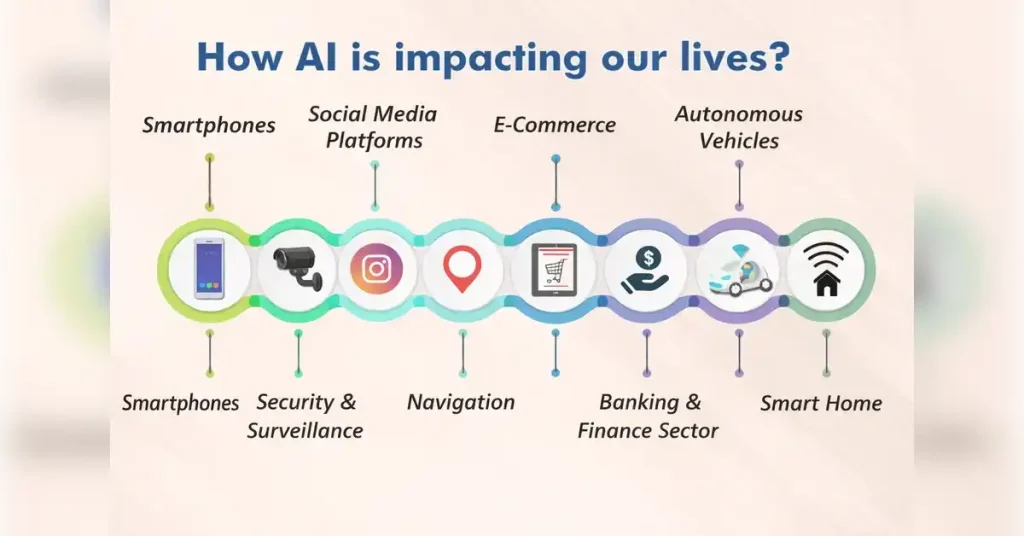
AI is already part of everyday technology. Smartphones use AI for face unlock. Streaming platforms recommend movies and music. Navigation apps predict traffic. Online stores suggest products. Video games use AI to control characters.
These examples show that AI is not a future idea—it is already shaping digital experiences.
Benefits of Learning AI for Beginners
Learning AI offers many advantages. It improves digital awareness, supports smarter decision-making, and opens new career opportunities. AI skills are also useful for freelancing, content creation, automation, and remote work.
For AI for Beginners, even basic knowledge helps you use modern tools more effectively and confidently.
Common Myths About Artificial Intelligence
Many people believe AI will replace all jobs. In reality, AI mainly automates repetitive tasks and supports human work. Another myth is that AI requires advanced mathematics. Beginners can learn AI concepts without complex math.
AI is also not only for engineers. Writers, marketers, designers, students, and business owners use AI tools daily.
Best AI Tools for Beginners
There are many beginner-friendly AI tools available today. Writing assistants help generate content, design tools create visuals, research tools summarize information, and productivity tools help organize tasks.
These tools allow AI for Beginners to start using artificial intelligence without technical skills.
How to Start AI for Beginners
The best way to start is by learning basic AI concepts and terminology. Next, begin using AI-powered tools in daily work. Focus on understanding how AI systems behave and make decisions.
Coding is optional and can be learned later if needed. Many people benefit from AI knowledge without ever writing code.
AI Career Paths for Beginners
AI-related careers are not limited to programmers. AI for Beginners can explore roles such as AI content specialist, prompt engineer, AI tool consultant, junior data analyst, or automation assistant.
Many professionals enter the field through AI-assisted roles and grow their skills over time.
Ethical Considerations When Using AI
AI should be used responsibly. Important concerns include data privacy, algorithm bias, misinformation, and the impact of automation on jobs. Ethical awareness is essential when learning and using artificial intelligence.
The Future of AI for Beginners
The future looks promising for AI for Beginners. AI tools will become easier to use, no-code platforms will grow, and AI literacy will become a basic requirement across industries. Human and AI collaboration will shape future workplaces.
Starting early gives you a strong advantage.
Frequently Asked Questions
Is AI difficult for beginners?
No. AI basics are easy to understand with the right guidance.
Do I need coding to learn AI?
No. Coding is optional at the beginning.
How long does it take to learn AI basics?
Usually two to four weeks with consistent learning.
Is AI a good career choice?
Yes. AI-related skills are in high demand worldwide.
Can beginners earn money using AI?
Yes. Many people earn through freelancing, content creation, and automation.
Final Thoughts
AI is not only for experts. This guide shows that AI for Beginners can understand and use artificial intelligence without fear or confusion. Learning AI today helps you stay relevant in a rapidly changing digital world.
👉 AI won’t replace you—but someone who knows how to use AI might.